AI & Product Design
Designing AI for Organizational Sensemaking
2026
How might AI help teams build shared understanding instead of simply generating answers?
Role
Product Designer, UX Researcher, Interaction Designer, Visual Designer
Engagement
Independent product concept
Research basis
Master's thesis research, covered by a confidentiality agreement
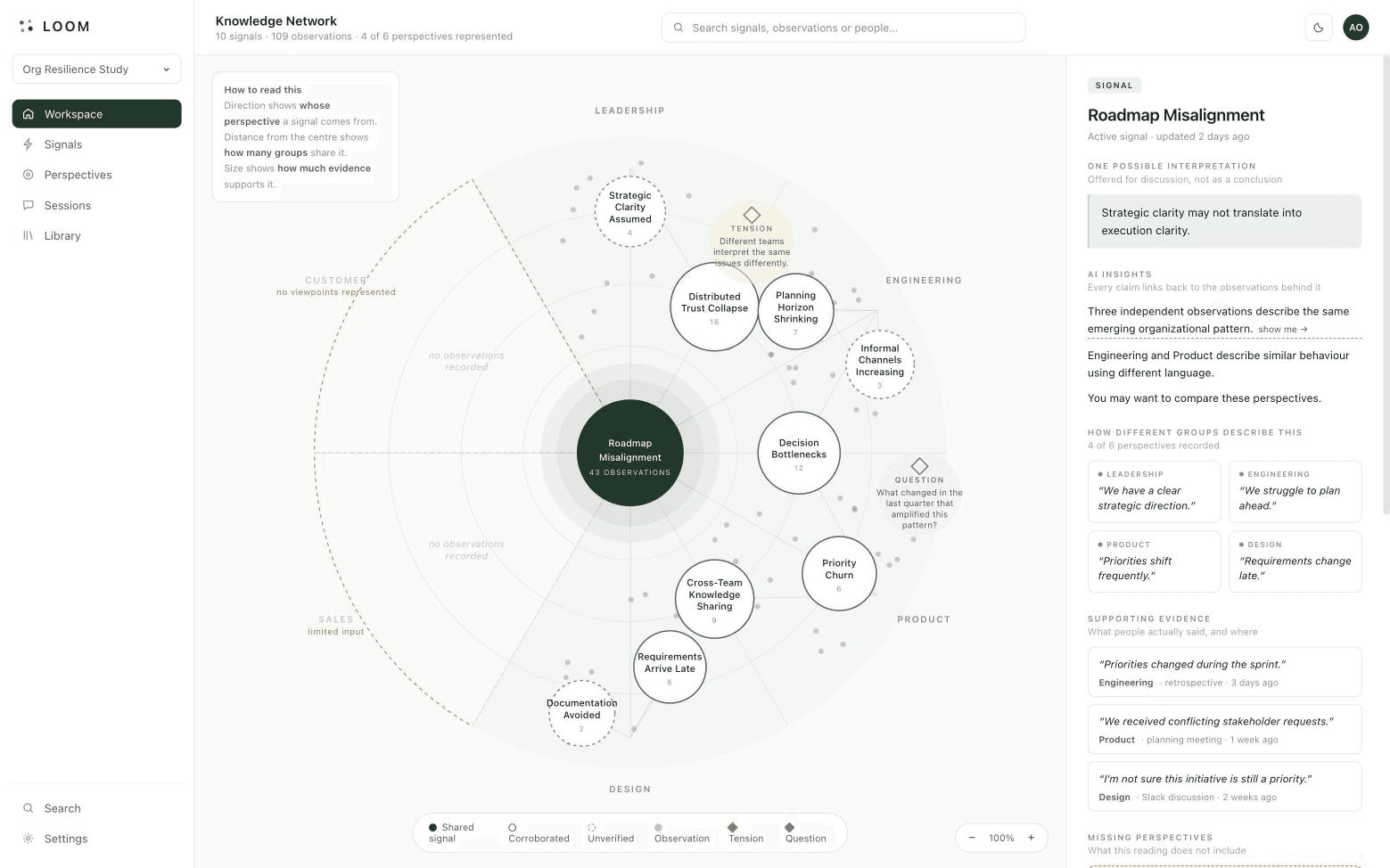
Prototype is best viewed on a larger screen.
Open in a new tabOverview
LOOM is a conceptual AI-powered workspace designed to support organizational sensemaking rather than information retrieval. It explores how AI can augment human interpretation while preserving uncertainty, context and collaboration.
Problem
Customer feedback, retrospectives, Slack conversations and research sit in different places, and AI tools summarize them without showing how relationships and perspectives shape a decision. They optimize for certainty, which is the wrong instinct for problems that are genuinely ambiguous.
Solution
Instead of a dashboard, LOOM visualizes knowledge as a network of relationships: observations connect to emerging signals, and perspectives supply the context teams need to interpret them together. I designed it with AI as a collaborator, using Figma Make and AI-assisted exploration for the visual language, which put me in the same relationship to AI that the product proposes: a partner in interpretation rather than a source of answers.
Results
- A relationship-centered interaction model where the network itself becomes the primary interface
- The LOOM Design Language, a visual grammar built from primitive elements that unifies branding, interface and interaction
- A concept in which uncertainty, multiple perspectives and organizational relationships are first-class design elements rather than problems to eliminate
Design decisions
Each of these is live in the prototype above.
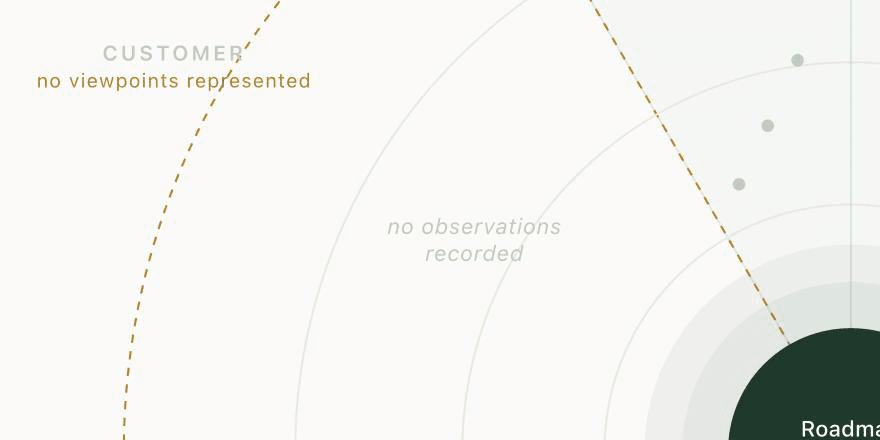
Missing perspectives
The interface reports what it does not know. Sales and Customer sit as visibly empty sectors on the canvas, and every signal lists the viewpoints its reading excludes. Most AI products hide their coverage gaps, because gaps undercut the impression of completeness.
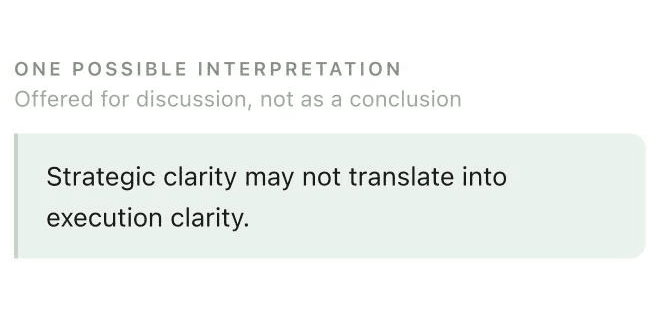
One possible interpretation
The label does the arguing. Readings are offered for discussion rather than presented as conclusions, and the AI keeps a hedged voice throughout: a pattern may be related, you may want to compare these perspectives. When two groups describe the same thing differently, that difference is kept and named rather than resolved away.
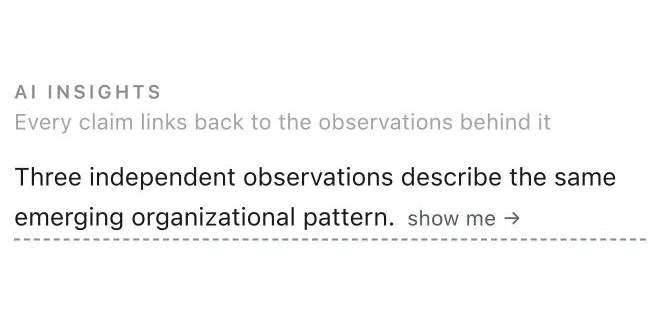
Claims you can audit
Every AI insight links back to the evidence beneath it. Clicking show me highlights the specific observations a claim rests on, one per source group, so the reader can check the reasoning instead of trusting it.
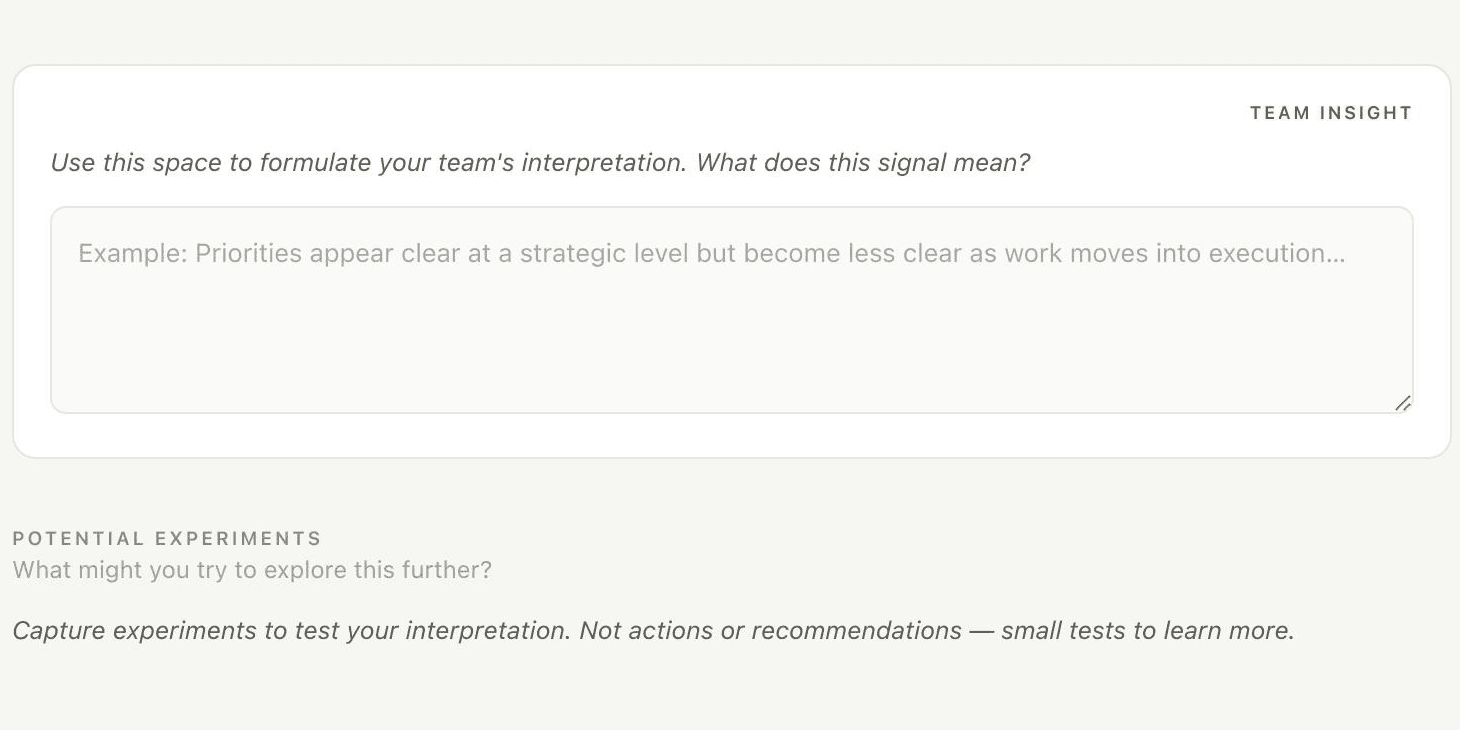
The box the AI leaves empty
In a sensemaking session, the most important field in the product is the one the system deliberately does not fill in. LOOM gathers the evidence; the team writes what it means. Experiments are framed as small tests to learn more, explicitly not as actions or recommendations.
Design Process
Research
LOOM builds on research insights from my master's thesis, carried out with an industry partner. That study is covered by a confidentiality agreement and cannot be shown here, so this case presents the design thinking it informed rather than the underlying research. The work draws on organizational sensemaking, AI-assisted collaboration, complex sociotechnical systems, Actor-Network Theory and knowledge visualization, and on the relationships between people, systems and organizational processes.
Iteration & Reflection
The concept went through three iterations. The first was a narrative, evidence-first flow built around attributed quotes and the perspectives a reading was missing. The second replaced it with a spatial knowledge network, which made relationships visible but lost the evidence trail that made the first version trustworthy. The current design is a synthesis of both: position encodes whose perspective a signal comes from, while every claim still links back to the observations beneath it.